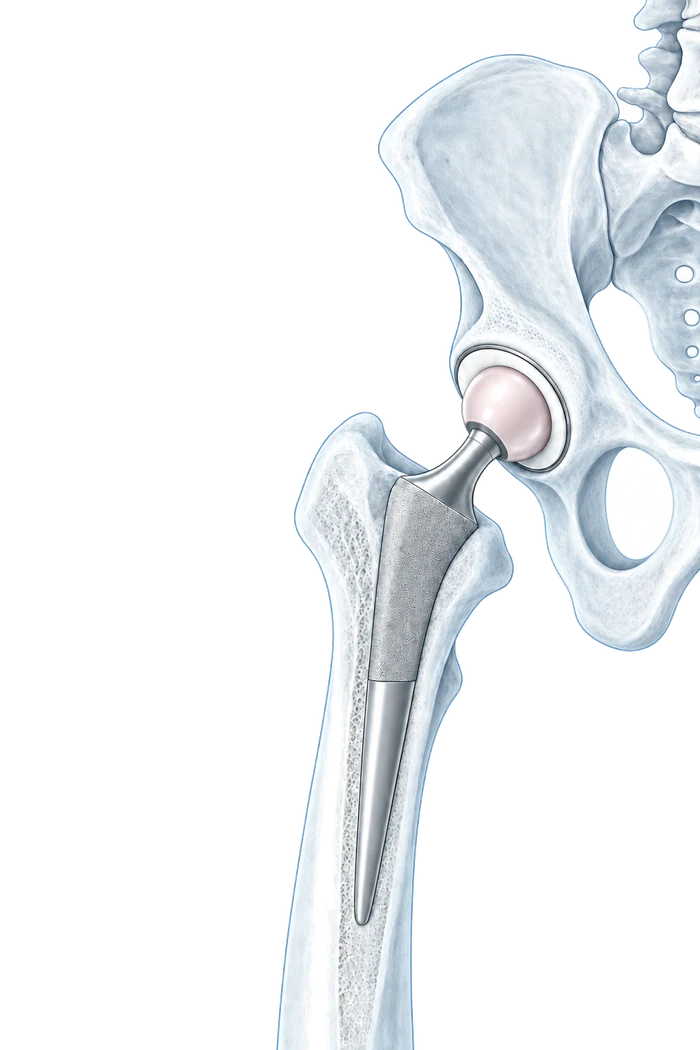
A realistic look at the expected recovery after a modern hip replacement
Andrew B. Harris, MD · Last reviewed August 2026
Recovery from a modern hip replacement is faster than most people expect. Many patients are up and walking with help the same day, some go home that day1, and many are back to most daily activities within two to three months2.
The problems patients most commonly run into early are bruising, stiffness, pain, and disturbed sleep. Patients who take an active role in their own recovery tend to have better outcomes, and going in with realistic expectations has been shown to matter as well.
Everyone’s timeline differs. Follow your own surgeon’s instructions.
The goal early on is comfort, safe walking, and protecting the incision. Most patients use a walker at first and move to a cane as balance and confidence return. How long to stay on a walking aid varies between surgeons. Some ask patients to stay on one for a set period rather than giving it up as soon as it feels possible, which is what Dr. Harris does. One of the main risks in the first few weeks is a fall, and a walker or cane is the simplest way to prevent one. Most patients only need one for a short time. In one study that surveyed patients every week after surgery, 91% were using a walking aid in the first week and 15% still were at six weeks.3
Swelling is very common after hip replacement, though a number of steps are taken during and after surgery to limit it. When it does occur, gravity pulls fluid down the leg, so it can show up in the thigh and sometimes into the calf and ankle. Sleep is often the hardest part of the first two weeks, although most people find a position that works to sleep as much as they can through the night.
There are usually some movements to avoid or limit for roughly six to eight weeks after surgery while the soft tissues heal. What those are depends on the specific operation you had, so the instructions you are given may not match what a friend was told after their hip replacement. Your surgeon will go through your specific movement limitations before you leave the hospital.
How much formal therapy a patient needs after hip replacement surgery varies. Some patients do best with outpatient physical therapy, meaning going to a PT office for scheduled appointments and sessions. Others do just as well with a self-directed home exercise program. Both of these options may work for different individual patients. The option that makes sense depends on the patient and on the exact surgery performed. A randomized trial found that many patients with a routine hip replacement do as well with a home exercise program as with formal therapy, and a review of seven trials found no meaningful difference in strength, function, or quality of life between supervised therapy and a home program.4,5 Your surgeon will recommend what fits your case.
What does not vary is that some amount of effort is required by the patient in order to achieve a full recovery. Regular, purposeful walking is the foundation and most important aspect of recovery, and the exercises you are given are there to rebuild the muscle that may have atrophied after years of dealing with arthritis or a period of weakness and lack of activity immediately after surgery.
Modern pain control after hip replacement minimizes narcotics such as oxycodone and Percocet, and relies instead on a multimodal regimen, meaning several different medications that work in different ways and are taken together. Dr. Harris uses this approach.
There are good reasons to keep narcotics to a minimum. They cause nausea, constipation, drowsiness, and mental fog. They also disrupt sleep rather than improving it. Narcotic medications make it harder to get up and walk, which is the single most important thing a patient can do in the first weeks. They also carry a real risk of dependence, lower when they are used briefly and as prescribed. Several non-narcotic medications used together can control pain well for many patients, with fewer side effects.
Minimizing narcotics does not mean accepting more pain. Both goals are very important, and keeping pain under control is a central part of the plan rather than something traded away.
Not everything that helps is a medication. Ice, elevating the leg, and changing position regularly can help reduce pain and swelling, and they work alongside the medications rather than instead of them.
Some patients need no opioid medication at all. Those who do need it usually take it for one to two weeks. Take it only as prescribed; your surgeon will tell you how to stop. Pain that is well controlled early makes it easier to walk, and walking is what drives the rest of recovery.
Two things determine when you can drive again after hip replacement surgery.
The first is that you cannot drive if you are still taking narcotic pain medication. The second is whether you can safely control the car, which means moving your foot to the brake without hesitating and getting in and out without difficulty.
A left hip usually allows a return to driving sooner than a right hip, since an automatic transmission does not require you to use a clutch with your left leg. Most patients are driving again within a few weeks. In one study that followed patients week by week, 60% were driving by four weeks and 77% by six weeks.3 Your surgeon will give you guidance based on your progress and which hip was operated on.
Desk work is usually possible within two to four weeks, and often sooner if you can work from home and change position when you need to. Physically demanding work takes longer to return to and is best done slowly over time. The exact time you could possibly return to a more physically demanding job depends on how much standing, lifting, and climbing the job involves. Your surgeon will tell you when it is safe for you to return to work.
| Week | Using a walker or cane | Driving again |
|---|---|---|
| Week 1 | 91% | 3% |
| Week 2 | 78% | 25% |
| Week 3 | 56% | 44% |
| Week 4 | 35% | 60% |
| Week 5 | 27% | 66% |
| Week 6 | 15% | 77% |
When to call. Call your surgeon’s office the same day for new calf pain or swelling of one leg, a fever, redness or drainage from the incision, or a sudden increase in pain or inability to put weight on the leg.
Call 911 or go to the nearest emergency department for chest pain, shortness of breath, coughing up blood, or confusion.
There may be some small speedbumps along the way, such as bruising and discomfort. For many patients these are minimal. Unplanned trips to an emergency department after hip replacement are uncommon, and when they do happen they are usually in the first two weeks, most often for pain or swelling.6 If you are worried, do not wait.
A few things are not a normal part of the recovery process, and these specific issues may need attention rather than waiting for your next appointment:
Shortness of breath, especially if it comes on suddenly or with chest pain, is an emergency.
Many patients return to low-impact activities such as walking, swimming, cycling, golf, hiking, and doubles tennis once their surgeon clears them. Whether any long-term limits apply depends on your hip and your surgery. Staying active is good for you and good for the muscles surrounding your hip replacement.
High-impact repetitive activity is a more open question. Whether distance running or extreme sports shorten the life of a hip replacement is still debated among surgeons, and the honest answer is that there is no definitive one. This is worth discussing with your surgeon individually rather than working from a blanket rule.
Modern hip replacements are also durable. Registry data covering nearly two million hips shows more than nine in ten still in place at twenty years, with about the same proportion projected at thirty.10,11
The anterior approach and the STAR approach are both modern, muscle-sparing techniques to perform hip replacement surgery, and patients often find the first few weeks easier than they expect. By three months the difference between approaches matters much less than the work you put in and how your hip was doing before surgery. Patients can do very well with both approaches. A study using motion sensors found small differences in walking between the anterior and posterior approaches in the first month, and no measurable difference by four months.7 The STAR approach preserves the piriformis and quadratus femoris muscles. Early studies, mostly from single centers, have reported good early results with the STAR approach.8,9
Patients are generally seen in the office after surgery to check the incision, review progress, and take an X-ray of the new hip. Later visits space out as you reach your final level of long-term recovery. Over a period of years, a hip replacement is worth checking periodically even when it feels perfect, because problems are easier to address when they are found early.
Most patients walk with assistance the same day or the next day, are moving comfortably around the house within a few weeks, and return to most normal activities within about two to three months. Recovery varies. It can take up to a year to feel the full benefit of the new hip, particularly if you had more stiffness or weakness prior to hip replacement surgery.
Most patients stand and take steps with assistance the day of surgery. Many use a walker or cane for the first few weeks, then progress to walking without aids as comfort and strength return.
Not while you are taking opioid pain medication, and not until you can move your foot to the brake without hesitating. A left hip usually allows driving sooner than a right hip. Most patients are back to driving within a few weeks. Your surgeon will tell you when it is safe for you to drive.
For many healthy patients, hip replacement can be done as an outpatient, same-day procedure with recovery continued at home, including with the anterior and STAR approaches. Whether that is right for you depends on your age, other health conditions, and home setup.
It depends. Some patients do best with formal outpatient physical therapy. Others do just as well with a self-directed home exercise program. Both can work well. Which one makes sense depends on the patient and the exact surgery performed, so follow the rehabilitation plan your surgeon recommends.
Pain after a hip replacement is generally managed with a multimodal approach that minimizes narcotics, combining several non-narcotic medications that work in different ways, along with ice, elevation, and regular movement. Dr. Harris uses this approach. Some patients need no opioid medication at all. Those who do need it usually take it for one to two weeks. Take it only as prescribed; your surgeon will tell you how to stop.
Desk work is usually possible within two to four weeks, and often sooner if you can work from home. Physically demanding work takes longer, depending on how much standing, lifting, and climbing is involved. Your surgeon will tell you when it is safe for you to return to work.
Usually there are some movements to avoid or limit for about six to eight weeks while the soft tissues heal. What those are depends on the specific operation you had, so follow the instructions you are given.
Many patients return to low-impact activities such as walking, swimming, cycling, golf, and hiking once their surgeon clears them. Whether any long-term limits apply depends on your hip and your surgery. Whether high-impact repetitive activity such as distance running shortens the life of a hip replacement is still debated among surgeons, so it is worth discussing with your surgeon, based on the activities that are important to you and the exact surgery you had.
Modern hip replacements are built to last. Registry data covering nearly two million hips shows more than nine in ten still in place at twenty years, with about the same proportion projected at thirty.10,11 In practical terms, the large majority of hip replacements are expected to still be working three decades later, and many patients will never need another operation on that hip.
General information for patients and clinicians, not a substitute for advice from your own surgeon.
If you are still deciding, the signs you may need a hip replacement guide may help. When you want to talk it through, send a message.