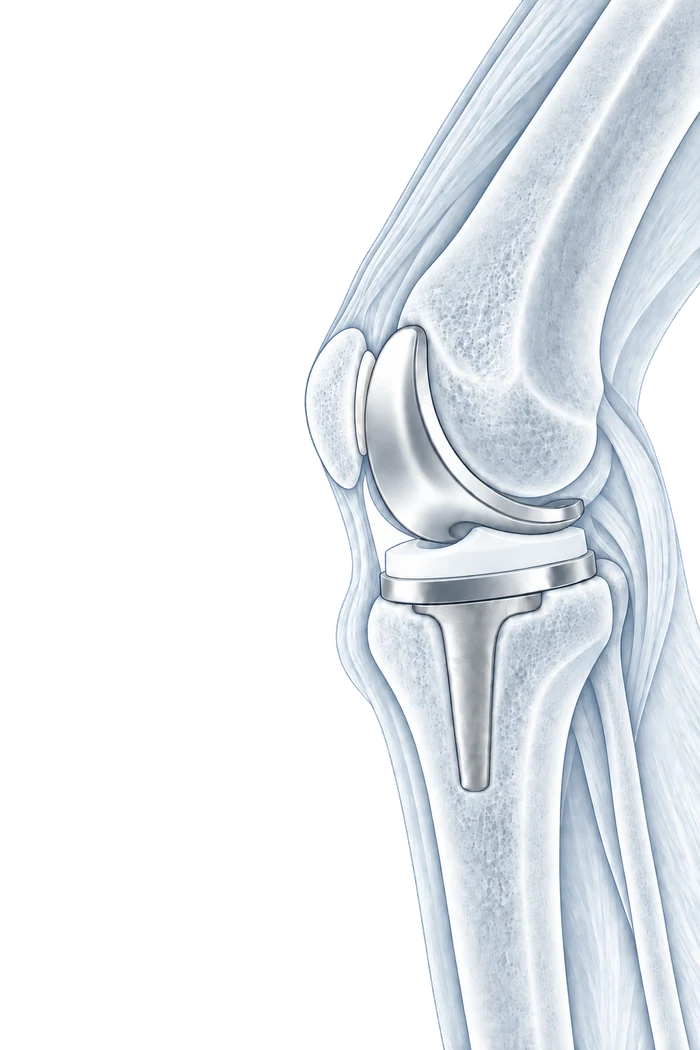
A realistic look at the expected recovery after a modern knee replacement
Andrew B. Harris, MD · Last reviewed August 2026
Recovery after a knee replacement is a stepwise process that has several milestones and is focused on achieving full knee motion and strength while also balancing discomfort. Although most people are up and walking with help the day of surgery, swelling and pain typically peak at around one week after knee replacement surgery,1 and motion and comfort goals have to be balanced alongside this. In general, most of the improvement happens in the first three months, although gains can continue for up to a year.
Swelling, warmth, stiffness, and some degree of mechanical clicking can be expected after knee replacement surgery, and these generally settle over time. Dr. Harris routinely uses robotic assistance or computer navigation to help position the implants.
Everyone’s timeline differs. Follow your own surgeon’s instructions.
The goals in this early recovery period are comfort, safe walking, controlling swelling, and starting to move the knee.
Patients are generally instructed to use a walker initially and move to a cane as balance and confidence return. One of the main risks in the first few weeks is a fall, and conservative use of assistive devices is recommended for safety and also for helping control extraneous movements, which can contribute to pain.
Icing and elevation are typically more important after a knee replacement than after a hip replacement. The knee sits just under the skin and can swell more, so regular icing throughout the day is important. Published protocols generally call for icing and elevating the leg for a substantial part of each waking hour through roughly the first two weeks after knee replacement surgery, with the toes kept above the level of the heart when elevating.2 Protect your skin, and follow your surgeon’s icing instructions. Some patients rent a cold therapy machine that circulates chilled water through a wrap. These are convenient, although they are not required. A bag of ice or a gel pack used regularly also works very well. Either choice is reasonable.
Getting the knee to bend and to straighten fully after knee replacement surgery are both important goals, and they compete for a patient's attention. Bending usually feels like the more obvious one, so extension is the goal that tends to get neglected. Extension, meaning the ability to get the knee completely straight, deserves as much attention as flexion. A knee that does not fully straighten changes how a patient walks and puts extra work on the quadriceps with every step. Extension that is lost early is generally harder to recover later, which is why therapy spends time on it from the beginning.
Most published protocols share the same basic idea about pacing. Short bursts of motion work spread through the day generally do more than one long session, and the work starts right away rather than waiting for a therapy appointment.2
Final motion varies from patient to patient and depends in large part on how much motion the knee had before surgery, so not every patient is held to a single number. Progress is also not necessarily linear. Most patients see rapid change in the first six weeks, then slower change that continues for months. What matters is that motion keeps improving and that the knee is getting fully straight.
A small number of patients find their motion after knee replacement surgery stalls despite doing therapy and knee exercises. When that happens, there may be a short procedure done under anesthesia to loosen up the scar tissue, which can help improve knee motion. In large database studies this is needed in roughly three percent of knee replacements.3 In even more rare cases, an additional surgery may be required to fully restore knee motion.4 Both of these situations are uncommon, and there is continued research being done on determining why some patients have more difficulty regaining knee motion than others. Younger patients appear to be at somewhat higher risk, and when the procedure is needed it generally works better when it is done early rather than late.3
Therapy and exercise are required after a knee replacement, and this is generally more important after a knee replacement than after a hip replacement. What is less important is where the exercises happen. Both formal outpatient physical therapy and a well-structured home program are reasonable choices, and studies comparing the two after knee replacement surgery have generally found similar range of motion, similar function scores, and similar complication rates.5 Some patients do better with the accountability and hands-on measurement that a therapist provides. Others do just as well working from a home program.
Regardless of the method, it is important to rebuild the muscle that weakened over years of arthritis and during the first weeks after surgery, and it is important that the exercises actually get done. Your surgeon can advise which approach makes the most sense for you.
Modern pain control after knee replacement seeks to minimize narcotics such as oxycodone and Percocet, and relies instead on a multimodal regimen, meaning several different medications that work in different ways and are taken together. Dr. Harris uses this approach.
There are good reasons to keep narcotics to a minimum. They cause nausea, constipation, drowsiness, and mental fog. They disrupt sleep rather than improving it. They make it harder to get up and do therapy, which is generally the single most important thing a patient can do after a knee replacement. They also carry a real risk of dependence, lower when they are used briefly and as prescribed.
Minimizing narcotics does not mean accepting more pain. Keeping pain controlled is a central and important goal, because a patient in too much pain may also be limited in their ability to perform therapy. In addition to medications, ice, elevation, and moving the knee regularly are all important to reduce pain and swelling.
Knee replacements are generally, although not always, more uncomfortable early on than hip replacements. Most patients who need narcotic medication after knee replacement surgery need it only briefly, usually for one to two weeks. Take it only as prescribed; your surgeon will tell you how to stop.
A knee replacement generally stays swollen and warm to the touch for much longer than patients expect, and this is one of the most common reasons for phone calls after surgery.
Warmth over the knee is expected as part of normal healing. Swelling fluctuates with activity rather than disappearing on a schedule, so a knee that looks better in the morning and puffier by evening is behaving normally. A busy day, more walking, or more time on the feet will typically show up as more swelling that night.
There is a well-described shape to this. Swelling generally rises quickly over the first few days after knee replacement surgery, peaks somewhere around six to eight days, and then declines gradually over the following weeks.1,6 How high that peak goes varies widely between patients. In one study that measured swelling directly, the least swollen patients peaked at roughly a quarter more volume than the other leg while the most swollen peaked at closer to half again, and even seven weeks after surgery every group was still measurably more swollen than the opposite side.1 The useful comparison is therefore the trend rather than the calendar. Swelling that is gradually less than it was a few weeks ago is on track, even if it has not gone away.
Peak swelling generally occurs about six to eight days after knee replacement surgery, and typically reaches roughly a third more volume than the other leg.1,6
| Weeks after surgery | Typical | Range |
|---|---|---|
| 0 | 0% | 0% |
| 1 (peak) | about 35% | about 25% to 47% |
| 2 | about 33% | about 24% to 45% |
| 3 | about 30% | about 21% to 42% |
| 5 | about 26% | about 17% to 39% |
| 7 | about 23% | about 13% to 36% |
Ice and elevation can be very helpful for both warmth and swelling. If there is ever a concern that anything is out of the ordinary, it is always best to call the office or have a visit scheduled sooner with your surgeon rather than to wait and wonder.
What is not expected is swelling that suddenly worsens, or swelling of the whole leg that is clearly different from the other side. This is general information about what typically happens after knee replacement surgery and it does not replace an evaluation. Any swelling that concerns you should be discussed with your own surgeon.
A replaced knee can sometimes, but not always, make clicking or clunking noises, particularly when straightening from a bent position. This is the sound of the metal and plastic surfaces moving against each other and it usually does not mean anything is loose or wrong. Some clicking can be a normal part of having a replaced knee.
Patients also describe the knee feeling different from their own knee, particularly in the first year. It can feel tight, or aware, or simply not like the knee they grew up with. This is common, and this sensation generally improves for most people as the soft tissues settle and the muscles get stronger. Studies that specifically measure how aware patients are of the replaced joint during everyday activity show the sharpest improvement over the first six months after knee replacement surgery, with scores continuing to hold for years afterward.7
Two things generally determine when a patient can drive again after knee replacement surgery. The first is that you cannot drive while still taking narcotic pain medication. The second is whether you can safely control the car, which means moving your foot to the brake without hesitating and getting in and out without difficulty.
A left knee usually allows a return to driving sooner than a right knee, since with an automatic transmission the right foot works the pedals. In a systematic review of braking studies, the time taken to move the foot to the brake returned to its pre-surgery level by about two weeks after a left knee replacement and about four weeks after a right one.10 That measures one part of driving rather than readiness overall, and timing still varies between patients, so ask your surgeon what they recommend in your specific situation.
Desk work is usually possible within a few weeks after knee replacement surgery, and often sooner for patients who can work from home, keep the leg elevated, and change position as needed. Physically demanding work generally takes longer and is best returned to gradually. How much standing, kneeling, lifting, and climbing the job involves determines the timing more than an exact timeline, and this often varies for each specific patient. Your surgeon will tell you when it is safe for you to return to work.
Whether a patient can kneel is one of the most commonly asked questions after a knee replacement. Kneeling is not thought to damage a knee replacement, and many patients can kneel comfortably with practice. Many find it uncomfortable at first, however, and some avoid it for that reason. The trouble is that avoiding kneeling tends to make it harder rather than easier over time.
There is good evidence that this is a comfort problem rather than a permanent limitation. In one study of patients after knee replacement surgery, most were already kneeling without much difficulty, and among those who reported trouble, patients who completed a simple graded program were afterward able to kneel without significant difficulty.8 That program was straightforward: about ten minutes of kneeling a day, starting on something soft such as a couch or cushion, and moving to a progressively firmer surface each week. Ask your surgeon when it is right for you to start.
Kneeling is generally reasonable to start once the incision has healed, and it is worth continuing to practice, because comfort generally improves with repetition. Your surgeon may recommend it. A cushion or folded towel under the knee can help early on with discomfort as you build up a tolerance to kneeling.
When to call. Call your surgeon’s office the same day for new calf pain or swelling of one leg, a fever, redness or drainage from the incision, or a sudden increase in pain or inability to put weight on the leg.
Call 911 or go to the nearest emergency department for chest pain, shortness of breath, coughing up blood, or confusion.
There may be some small speedbumps along the way, such as bruising, swelling and discomfort. For many patients these are minimal after a knee replacement with modern techniques.
A few things should be mentioned that are not a normal part of the recovery process, and these specific issues may need more urgent attention rather than waiting for a scheduled follow-up appointment:
Shortness of breath, especially if it comes on suddenly or with chest pain, is an emergency.
Most patients have very few long-term activity restrictions after a knee replacement. Walking, swimming, cycling, golf, hiking, and doubles tennis are all reasonable and many patients return to these activities after surgery. Staying active is good for the patient and good for the muscles that support the knee.
High-impact repetitive activity is a more open question. Whether distance running or extreme sports shorten the life of a knee replacement is still debated among surgeons, and the honest answer is that there is no definitive one. If you want to return to high-impact activity after a knee replacement, this is best reserved for an individual discussion with your surgeon.
Patients are generally seen in the office after surgery to check the incision, review motion and overall progress, and take an X-ray of the new knee. Later visits typically space out as recovery reaches its final level. Over a period of years, a knee replacement is worth checking periodically even when it feels perfect, because problems are easier to address when they are found early.
Modern knee replacements are built to last, and more than eight in ten total knee replacements are still functioning twenty five years after surgery.9 Periodic X-rays over those years are generally how a problem gets found while it is still small.
Most patients walk with assistance the day of surgery, make the large majority of their progress in the first three months, and continue improving for up to a year. Consistent participation in a structured exercise or therapy program is generally a very important factor in achieving a good result.
Most patients stand and take steps with assistance the same day. A walker or cane is typically recommended for the first few weeks, with a steady progression to walking unaided as motion and strength return.
Not while taking narcotic pain medication, and not until you can move your foot to the brake without hesitating. A left knee usually allows driving sooner than a right knee, since the right foot works the pedals. Brake reaction time has generally returned to its pre-surgery level by about two weeks after a left knee replacement and about four weeks after a right one.10 The exact timeline should be discussed with your surgeon and your specific situation.
You will need to do the exercises. Where you do them is more flexible. Formal outpatient physical therapy and a well-structured home program have generally produced similar motion and function after knee replacement surgery, so either is a reasonable choice. What is not optional is doing the work consistently, since that is what rebuilds motion and quadriceps strength.
It depends on the individual knee, including how much motion your knee had before surgery, so there is no single number that applies to everyone. Most patients gain motion quickly in the first six weeks and keep gaining more slowly for months after that. Getting the knee fully straight is important equally as much as getting it to bend fully.
Warmth and swelling can last far longer after a knee replacement than most patients expect. Swelling typically rises over the first several days, peaks about a week after surgery, and then comes down gradually over the following weeks. It also fluctuates with activity, so a knee that is puffier by evening is behaving normally. What is not expected is swelling that suddenly worsens or a leg that is clearly different from the other side, and if there is ever a question about your level of swelling it is best to contact your surgeon with a photo or an in-person evaluation. Swelling of the whole leg or calf pain can be a sign of a blood clot; call the office the same day, and call 911 if you also have chest pain or trouble breathing.
Yes, this can be very normal. A replaced knee often has a light clicking sensation, particularly when straightening from a bent position. It is the sound of the metal and plastic surfaces moving against each other and it does not necessarily mean anything is loose or wrong. Sudden clicking or popping that was not present initially should be evaluated further by your surgeon.
Yes. Kneeling is not thought to damage a knee replacement, and many patients can kneel comfortably with practice. Many find it uncomfortable at first, and avoiding it tends to make it harder rather than easier over time. In one study, most patients after knee replacement surgery were already kneeling without much difficulty, and a graded kneeling program (about ten minutes a day, starting on a soft surface such as a couch or cushion, then moving to a firmer surface each week) helped patients who had trouble kneeling. Ask your surgeon when it is right for you to start. It is generally reasonable to start once the incision has healed and to keep practicing, since comfort generally improves with repetition. Your surgeon may recommend it. A cushion or folded towel under the knee helps early on.
Pain after a knee replacement is generally managed with a multimodal approach that minimizes narcotics, combining several non-narcotic medications along with ice, elevation, and regular movement. Dr. Harris uses this approach. Most patients who need narcotic medication after knee replacement surgery need it only briefly, usually for one to two weeks. Take it only as prescribed; your surgeon will tell you how to stop.
Desk work is usually possible within a few weeks, and often sooner for patients who can work from home and keep the leg elevated. Physically demanding work generally takes longer, depending on how much standing, kneeling, lifting, and climbing is involved. Your surgeon will tell you when it is safe for you to return to work.
Modern knee replacements are built to last. In the largest analysis of long-term registry and study data, more than eight in ten total knee replacements were still functioning at twenty five years,9 and many patients will never need another operation on that knee.
General information for patients and clinicians, not a substitute for advice from your own surgeon.
If you are still deciding, the signs you may need a knee replacement guide may help. When you want to talk it through, send a message.