Andrew B. Harris, MD · Last reviewed September 2026
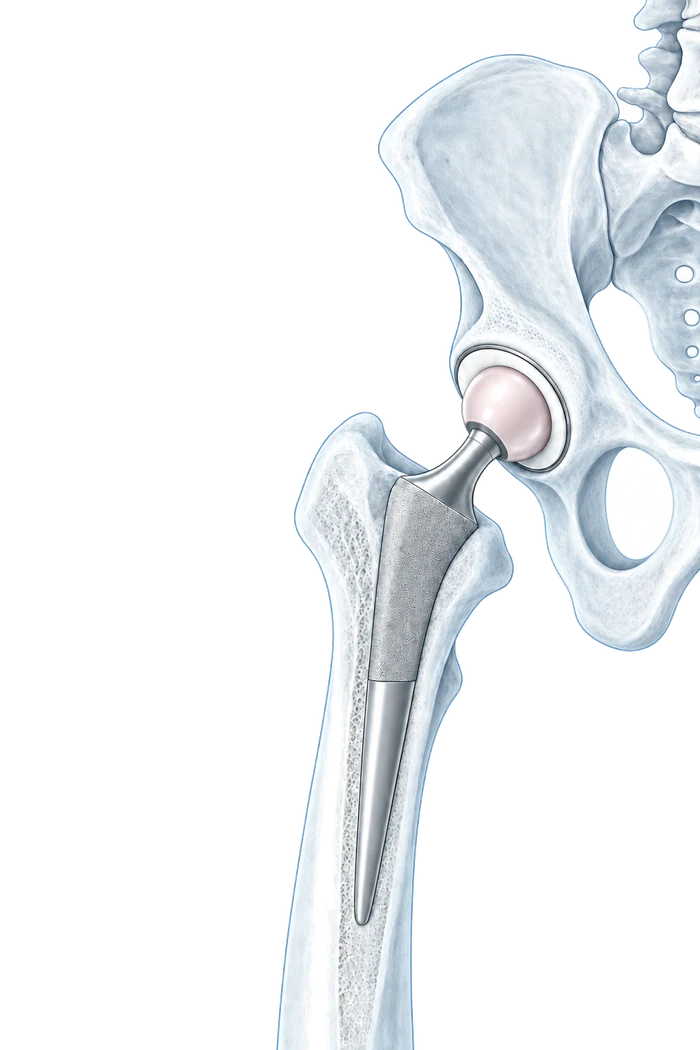
Revision joint replacement surgery replaces part or all of an existing hip or knee replacement. Sometimes that means exchanging one worn implant. Sometimes it means removing components that are fixed to bone and rebuilding the joint with implants designed for bone that has changed since the first operation.
The first task is working out why the existing joint replacement is failing. That diagnosis should be clear before anything else is decided, including whether surgery is the right answer at all. Dr. Harris, a joint replacement surgeon in Chicago, evaluates hips and knees that have become painful or unreliable, including joint replacements done by other surgeons.
A first hip or knee replacement is an elective surgery. A revision is not always elective. Loosening and wear usually leave time to plan the surgery. Infection and a fracture around an implant often have to be treated on a more urgent basis.
Any of these can be a reason to have a hip or knee replacement evaluated:
An implant is "attached" to the bone one of two ways. Either bone grows onto a textured surface, or the component is fixed to the bone with PMMA cement. Both bonds can fail over time, and when they do the implant starts to move against the bone instead of with it. Loosening usually shows up as pain on weight bearing, often worst for the first few steps after sitting.
Wear is a different problem. Every joint replacement has a bearing surface where the two halves of the joint move against each other, and that surface wears slowly. The particles it releases can cause the bone around the implant to thin, which loosens components that were solid to begin with. Modern bearing materials wear far more slowly than older ones, which is a large part of why current hip replacements can last for 30+ years.5
X-rays taken over time are far more useful than a single film. A thin dark line appearing along the edge of an implant, a component that has shifted position, or bone that has thinned where it used to be solid all point toward loosening. Old films are worth tracking down if you are going to see a specialist about considering a revision surgery, including the ones from before the first joint replacement. A CT scan is sometimes added when bone loss or component position needs to be measured. Aseptic loosening and wear account for a large share of revisions in the United States.1
Not every revision means taking all of the implants out. If a plastic liner has worn but the metal components are solidly fixed and well positioned, exchanging the liner may be enough. If a component is loose it comes out and is replaced, sometimes with a longer stem or a larger socket that reaches bone still solid enough to hold.
Bacteria can settle on the surface of an implant. This sometimes happens in the weeks after surgery and sometimes years later, when bacteria travel through the bloodstream from an infection somewhere else in the body. A joint replacement that was comfortable for years and has become painful, swollen, or warm should be checked.
No single test makes the diagnosis of infection. The diagnosis comes from a combination of blood markers, and fluid drawn from the joint. A scoring system weighs those results together.2 This has to be sorted out before surgery, because an infected joint replacement and a loose one are treated completely differently.
Treatment of a joint infection depends on how long symptoms have been present, which organism is involved, and whether the implant is still solidly fixed. Infection caught within a few weeks can sometimes be treated by "washing out" the joint with high volumes of sterile saline and exchanging the removable parts, leaving the fixed components in place. An established infection usually means the implants have to be removed for a complete treatment of the infection.
There are two ways to accomplish the treatment of infection if implants have to be removed. In a single-stage revision the joint is cleaned out and new implants go in during the same operation. In a two-stage revision the implants are removed, a temporary spacer holds the space and delivers antibiotics locally, weeks of antibiotic treatment follow, and new implants go in at a second operation. A randomized trial comparing the two in hips found function at 18 months was about the same either way, with faster early recovery after a single-stage revision.3 Antibiotics are usually given for weeks either way, managed together with an infectious disease specialist.
A hip replacement can dislocate when the ball comes out of the socket. When this happens, it is obvious and painful, and the hip has to be put back in place, usually under sedation in an emergency room. One dislocation is not automatically a reason to need a revision surgery. Repeated dislocations, however, usually are.
The reasons for dislocation can vary. Components can sit in a position that limits how far the hip moves before it levers out. The soft tissues around the hip can be lax, or the muscles that hold the hip steady can be weak. A stiff lower back changes how the pelvis tilts between sitting and standing, which changes where the socket is pointing at any given moment. A worn liner can also let the ball ride out of position.
Revision for instability is aimed at whichever factor is found to be responsible for the dislocation that is occurring. That can mean repositioning a component, changing the size of the ball, changing the bearing so the joint tolerates more movement before it levers out, or restoring soft tissue tension by adjusting how far the hip sits out from the pelvis. Instability is among the more common reasons hips and knees are revised.1
A knee that is unstable is different than a hip, as knees generally do not dislocate, although this is possible. Knee replacements that are unstable can give way, usually while going down stairs or turning. This can happen if the ligaments that balance the knee may have stretched or been injured, or the components may not be balanced against each other through the full arc of motion. Revision generally means moving to components that supply more stability.
A periprosthetic fracture is a break in the bone next to a hip or knee replacement. Most of the time, this happens after a fall. The bone right around an implant is sometimes not as strong as normal bone. A fall that would otherwise have caused a bruise can crack the femur beside a hip stem or just above a knee replacement.
Treatment depends on whether the implant is still solidly fixed. If it is, the fracture is repaired around it with plates, screws, and cables, and the joint replacement stays where it is. If the implant has loosened, the fracture and the implant are dealt with together, usually with a longer stem that passes the fracture and takes hold in bone further down the leg.
A fracture like this is rarely something a patient can wait on. Most arrive through the emergency room and are treated within a few days. Fractures around hip replacements have increased faster than any other reason for hip revision over the past two decades. More joint replacements are being done, and patients are living longer with them.1
Some joint replacements hurt and the workup does not show a specific reason. This happens more often with knees than with hips.
The workup for a painful joint replacement typically goes in order. Infection is ruled out first, because it is the one cause that changes the whole plan. After that comes implant position, alignment, and rotation, then the soft tissues around the joint, then sources outside the joint entirely. Hip pain sometimes comes from the lower back. Knee pain sometimes comes from the hip. Nerve irritation can produce pain that has nothing to do with the implant. A revision has a reasonable chance of working once the specific cause has been identified.4
When no cause is found, an additional surgery to revise the implant(s) usually does not help and is not recommended.
Revision surgery varies depending on what exactly is being done. The smallest version exchanges a worn liner and leaves everything else alone. A step up from that, one component is replaced and the other stays. The largest version takes everything out and rebuilds the joint with implants that reach past the damaged bone, sometimes with bone graft or metal "augments" filling what is missing.
Patients recover more slowly from a revision surgery than from a first joint replacement, and recovery varies a great deal more from one person to the next. Some patients are asked to limit weight on the leg for a period, depending on what was done and how solid the fixation is at the end of the case. A revision for infection takes the longest, since antibiotic treatment runs alongside the recovery and a two-stage revision means that two operations are performed.
Revision surgery is more technically challenging than a first-time joint replacement and the results are less predictable. The bone around implants that have failed has often softened or weakened, the soft tissues have been operated on before, and the implants have to work with what is there. How well a revision does depends heavily on why it was needed in the first place. A worn liner exchanged in a well-positioned hip is a different situation from a knee rebuilt after infection.
Dr. Harris is open to seeing patients whose original surgery was done elsewhere. Some of these patients may have been told they need a revision and want another opinion before committing to it. Some have a joint replacement that hurts and have not been given an explanation. Some had their surgery years ago with a surgeon who has since retired or moved away.
The visit is mostly review and examination, and most patients leave it with a clearer idea of what is going on than they came in with. Bringing records makes it much more useful, because most of the answer is usually in the implant history. If something is missing the office can request it, though that takes time and is worth starting before the appointment.
A revision replaces part or all of a hip or knee replacement that is already in place. It can be as limited as exchanging one worn plastic liner, or as involved as removing every component and rebuilding the joint with implants designed for bone that has changed since the first operation.
A joint replacement that has become painful, unstable, or less reliable than it was should be evaluated, but symptoms alone do not settle it. The cause is usually identified with X-rays taken over time, blood work, and often fluid drawn from the joint. Some painful joint replacements turn out not to need surgery at all. Your own imaging and history are worth going through with an orthopaedic surgeon before you draw any conclusion from them.
No. If a liner has worn but the components fixed to bone are solid and well positioned, exchanging the liner may be all that is needed. If a component has loosened it comes out and is replaced. What gets exchanged depends on what is wrong, and an orthopaedic surgeon can tell you which of these applies to you once the workup is done.
Modern hip and knee replacements can last for 30+ years. Bearing surfaces wear far more slowly than they did in earlier implant generations, and most patients never need a revision. Age at the first joint replacement makes a difference. Someone who has a hip replaced at 55 has more years to cover than someone who has it done at 75.
Yes. Revisions take longer, involve more blood loss, and carry higher rates of infection and complication than a first joint replacement. The bone and soft tissues have been operated on before and are not what they were. That is why the decision to revise is not made until the cause is understood. The risk in your own case is something to discuss directly with an orthopaedic surgeon.
Longer than after a first joint replacement, and more variable. Weight bearing is sometimes restricted for a period depending on what was done. A revision for infection has the longest course of all, because antibiotic treatment runs alongside the recovery and a two-stage revision means two operations. Ask an orthopaedic surgeon what the timeline looks like for the specific operation you are having.
Sometimes. Infection caught within a few weeks of surgery, or shortly after symptoms start, can sometimes be treated by washing out the joint and exchanging the removable parts while the fixed components stay. Once an infection is established, the implants usually have to come out. Which of these applies depends on timing and on the organism involved, so it should be worked out with an orthopaedic surgeon rather than assumed.
Not necessarily. A single dislocation is often treated by putting the hip back in place and then working out why it happened. Repeated dislocations are a different situation and usually do need surgery, aimed at whatever is allowing the hip to come out. Whether you need an operation after one dislocation is a decision to make with an orthopaedic surgeon who knows your case.
A normal-looking X-ray rules out some causes and not others. Infection, component rotation, soft tissue problems, and pain coming from the back or from a neighboring joint can all produce a painful joint replacement with unremarkable films. The next step is a full workup, and an orthopaedic surgeon should go through the results with you before any decision about surgery is made.
Yes. He sees second opinions regularly. Bringing the operative report, the implant information, and all previous X-rays, including the oldest ones, makes the visit much more useful.
General information for patients and clinicians, not a substitute for advice from your own surgeon.
If an older hip or knee replacement has become painful or unreliable, it is worth finding out why. Dr. Harris sees these cases regularly and is glad to take a look. Get in touch whenever you’d like.