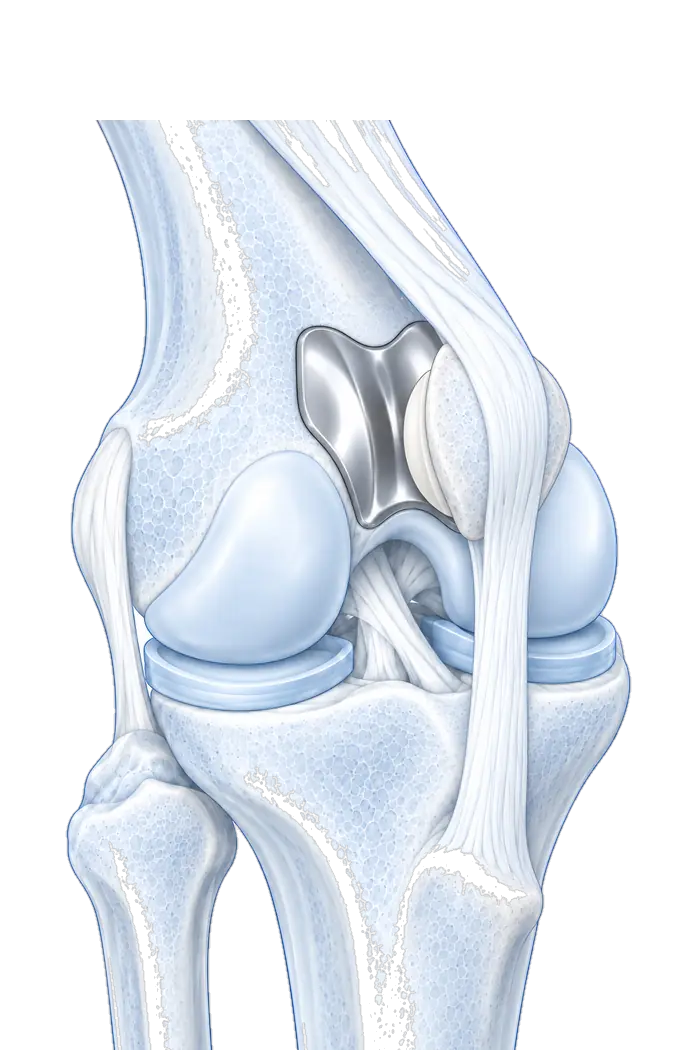
An overview of modern patellofemoral joint replacement for patients and other healthcare providers
Andrew B. Harris, MD · Last reviewed September 2026
The kneecap slides in a groove at the front of the thigh bone. When the cartilage on those two surfaces wears out and the rest of the knee is still in good condition, that joint can be resurfaced on its own. Patients often call this surgery a "kneecap replacement".
Patellofemoral joint replacement is one type of partial knee replacement. The inner and outer compartments of the knee are left untouched, along with both cruciate ligaments (ACL and PCL).
Dr. Harris offers this operation, but it is less common for patients to undergo this surgery compared to other types of knee replacement surgery. Arthritis that stays confined to the kneecap joint is not a frequent pattern, and some patients who ask about this surgery eventually turn out to be better served by a total knee replacement.
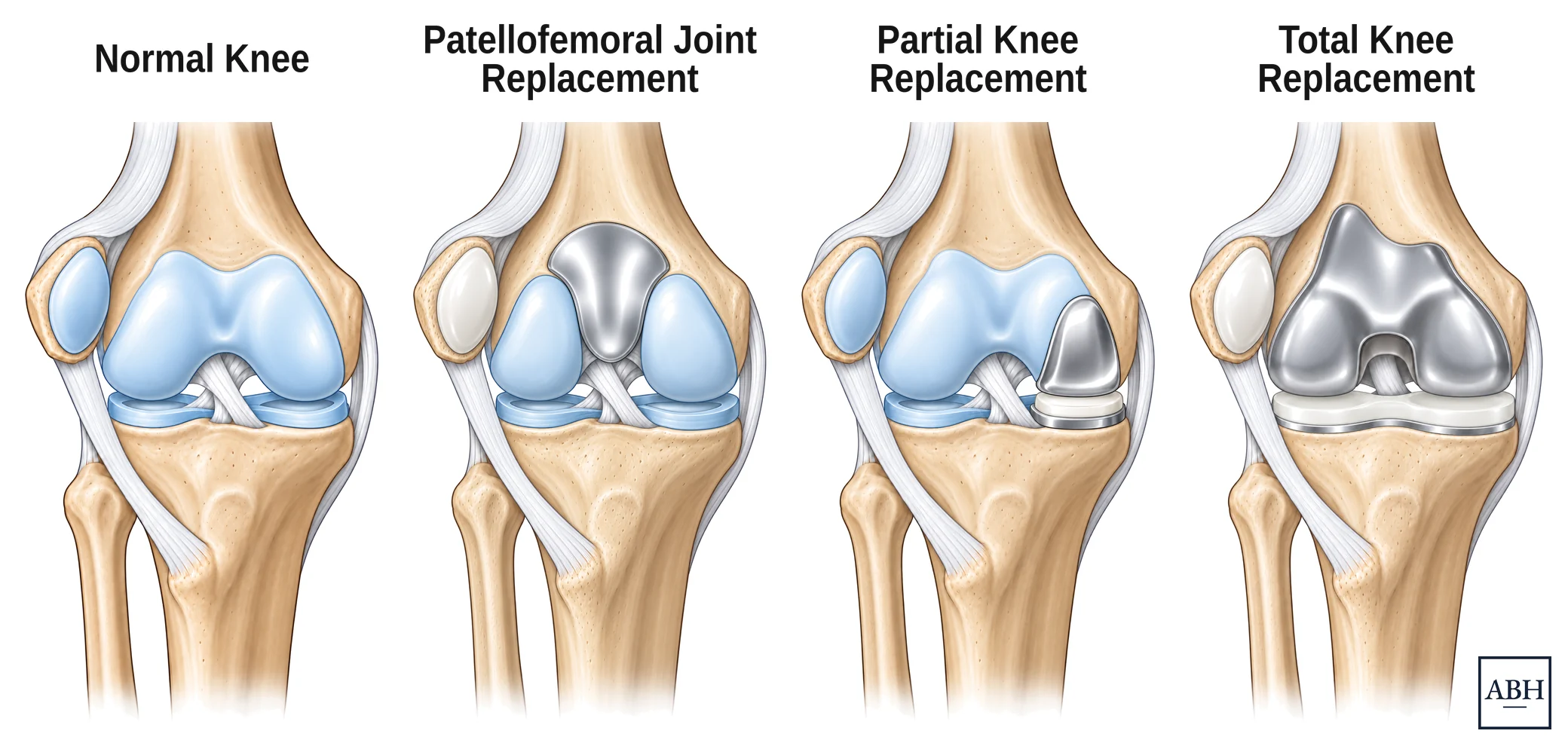
One knee, then the three operations. How much of the joint is resurfaced follows how much of it is worn.
A knee replacement is rarely something a patient strictly "needs". It is an elective operation, and there is no point at which surgery becomes mandatory. The right time is when the joint limits the patient’s life, non-surgical care is no longer enough, and the patient decides they are ready.
Osteoarthritis is the most common reason the kneecap joint wears out, but not the only one. Damage years after a kneecap fracture or a dislocation can produce the same pattern, and so can a groove that was shallow to begin with.
Before an operation is being considered, the usual non-surgical measures deserve a proper trial: physical therapy aimed at the quadriceps and the hip, activity changes, weight management where it applies, and injections. The alternatives page goes through these in detail.
Arthritis that extends beyond the kneecap joint is the main factor, and this is the reason most patients who ask about this operation have something else instead. If the inner or outer compartment is also worn, resurfacing the front of the knee leaves the painful part untreated. A total knee replacement is generally the better answer in that situation.
This is why the imaging matters to help make a decision. Pain at the front of the knee is common in arthritis generally, including in knees where the wear is mostly elsewhere. Specific X-ray views of the kneecap joint, sometimes with an MRI, are what separate the two.
Even in a knee that fits the criteria for a patellofemoral joint replacement, the arthritis can progress into the rest of the joint later. That is the single most common reason a patellofemoral joint replacement eventually needs further surgery.1
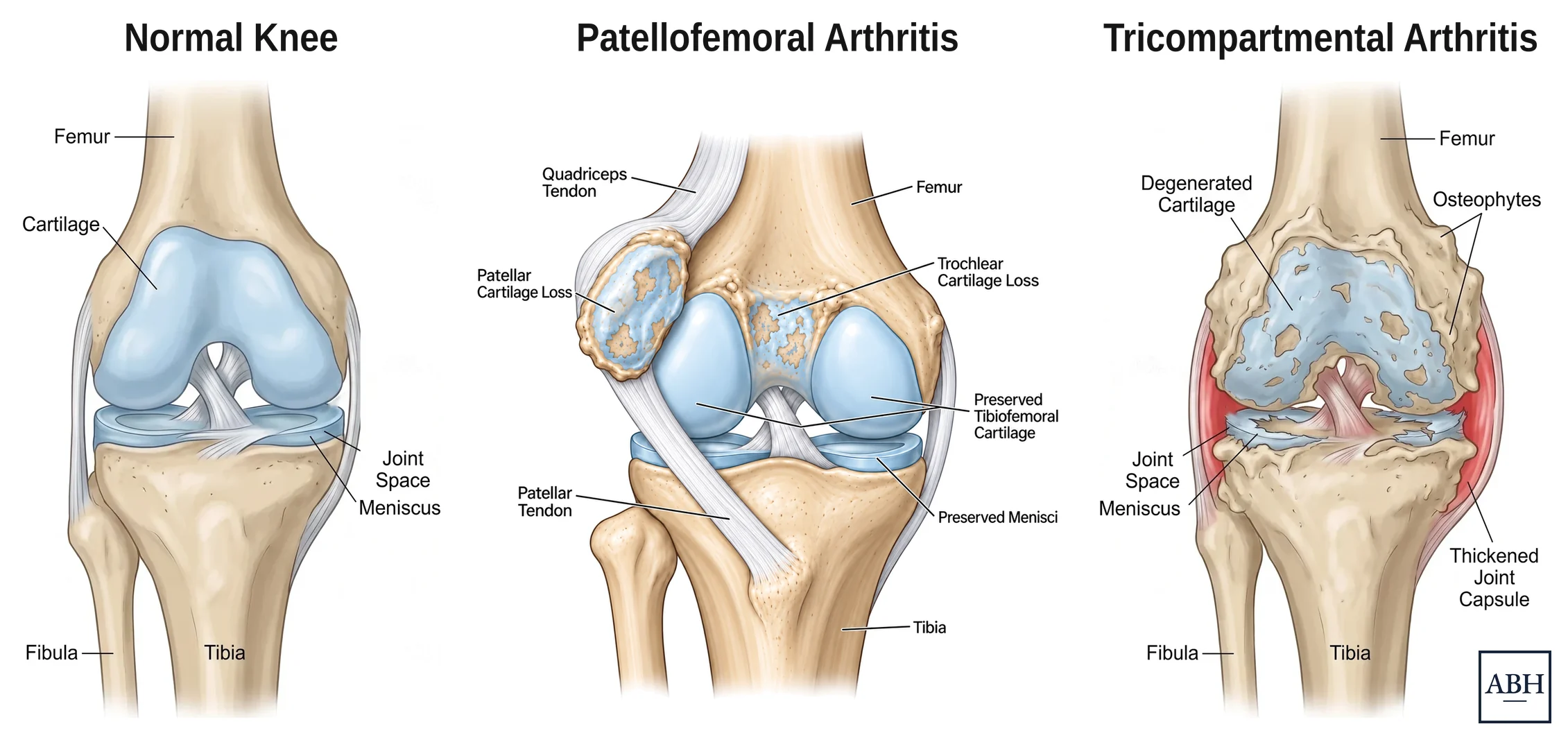
A knee in three states. Patellofemoral arthritis stays at the kneecap joint, which is what makes resurfacing that joint on its own possible.
Pooling published series and registry data, roughly 90 percent of patellofemoral joint replacements are still in place at five years and 82 percent at ten.1 The Norwegian registry puts ten-year survival at 85 percent, against 94 percent for a total knee replacement.2 That discrepancy is worth knowing before choosing this operation.
Age is also part of the picture. Patients having this operation are considerably younger than those having a total knee replacement, a mean of 54 against 69 in the Norwegian data, so they have far more years to cover. Among patients under 60, the ten-year revision risk after a patellofemoral joint replacement was comparable to a total knee replacement.2
If there is progression of arthritis in other compartments years later, a patellofemoral joint replacement can be converted to a total knee replacement in the large majority of cases. That conversion is generally more straightforward than revising a total knee replacement, since the inner and outer compartments have not been operated on.
The counterweight is that for the correct patient a patellofemoral joint replacement treats the problem with a smaller operation, keeps the ligaments, and leaves a total knee replacement available later.
The worn groove at the front of the femur is resurfaced with a metal component and the back of the kneecap with a plastic one. Everything else in the knee is left alone. Robotic assistance is sometimes used, since the component has to sit so that the kneecap tracks over it smoothly through the full range of motion.
Most patients go home the same day. Walking starts the day of surgery, and physical therapy begins straight away, focused on range of motion. Because the operation is smaller than a total knee replacement, the first few weeks are usually easier.
The risks are those of any knee replacement: infection, blood clots, stiffness, and the possibility of further surgery. One risk that is relatively specific to this operation is that the kneecap can have problems tracking over the new joint surface, which can cause ongoing front-of-knee pain. Dr. Harris goes through individual risk case by case.
It resurfaces the joint between the kneecap and the groove at the front of the thigh bone, and leaves the rest of the knee alone. Patients sometimes call it a kneecap replacement. It is one type of partial knee replacement.
Uncommon. Arthritis confined to the kneecap joint, with the rest of the knee still in good condition, is not a frequent pattern. Dr. Harris offers it for the patients who actually fit, and recommends a total knee replacement for the many who do not.
Pain at the front of the knee that is worse going up and down stairs, getting out of a chair, or sitting with the knee bent for a long time points that way. X-rays taken in specific views show the kneecap joint, and sometimes an MRI or CT adds detail. None of that is something to judge from symptoms alone, so it needs an orthopaedic surgeon to look at the imaging with you.
Arthritis that extends beyond the kneecap joint. If the inner or outer compartment is also worn, resurfacing only the front leaves the painful part untreated, and a total knee replacement is the better operation. This is the most common reason a patient asking about it ends up having something else.
Pooled data across published series and registries puts survival around 90 percent at five years and between 82 and 85 percent at ten. That is lower than a total knee replacement over the same period, which runs about 94 percent at ten years. Whether those numbers are the right ones for your knee depends on your age, your activity and your anatomy, which is a conversation to have with an orthopaedic surgeon.
It is converted to a total knee replacement. That is what happens in the large majority of cases that need further surgery, and it is generally more straightforward than revising a total knee replacement.
Most patients do. It is a smaller operation than a total knee replacement. As with any same-day surgery it depends on general health and on having support at home, so it is planned beforehand.
Sometimes. Getting the implant seated correctly in the groove matters a great deal in this operation, since the kneecap has to track over it through the full range of motion.
General information for patients and clinicians, not a substitute for advice from your own surgeon.
Whether it is coming from the kneecap joint alone, and whether that makes this the right operation, comes down to what the imaging shows. Dr. Harris reviews it and explains what he would recommend and why. Send a message.