An explanation of robotic-assisted total and partial knee replacement for patients and other healthcare providers
Andrew B. Harris, MD · Last reviewed September 2026
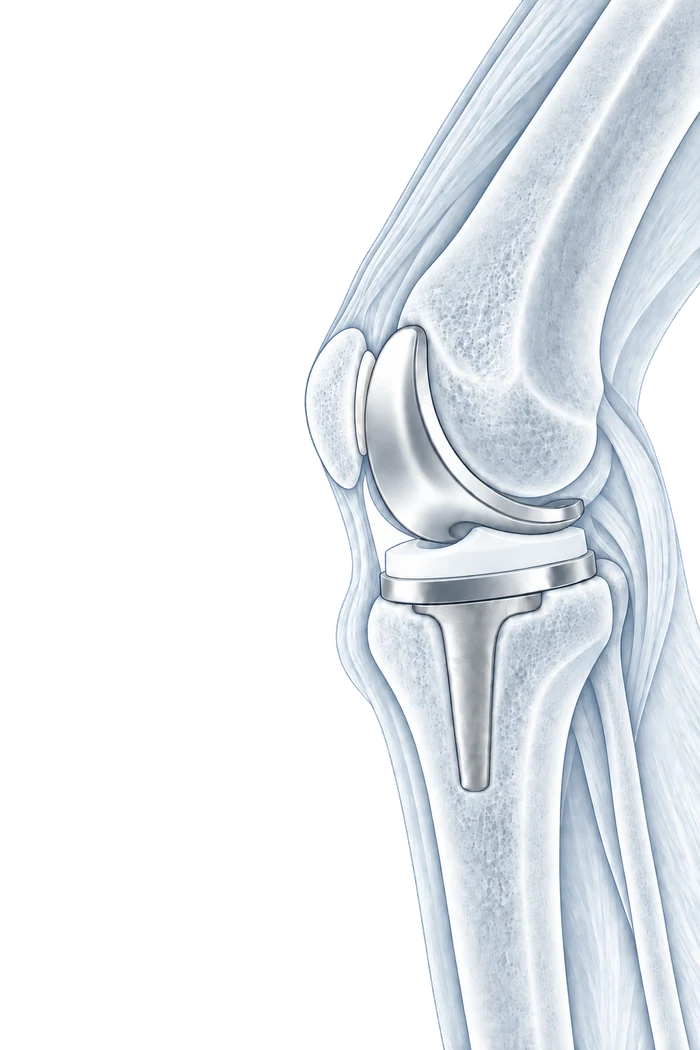
Despite the name, a knee replacement is closer to a “resurfacing” of the knee. The worn cartilage and a thin layer of bone are removed from the ends of the thigh bone and shin bone, then capped with smooth metal and plastic surfaces, much like a dentist crowns a damaged tooth.
Dr. Harris routinely uses robotic assistance or computer navigation to help position the implants. With these systems, the operation is planned from the patient’s own imaging and the plan is refined in the operating room. Modern knee replacements are durable, and can last for 30+ years.4,5
For arthritis, a knee replacement is usually an elective operation, and the timing is largely your choice. Some problems, such as certain fractures, collapse of the bone, or infection, are treated sooner; your surgeon will tell you if one applies. The right time is generally when the joint limits the patient’s life, non-surgical care is no longer enough, and the patient decides they are ready.
The planning for a given patient is typically performed before the operation from the patient’s own imaging. The surgical plan sets where the implants should sit and how much bone needs to be removed to place them there.
In the operating room the system tracks the position of the leg and the instruments in real time, so the bone cuts and the final implant position follow that plan rather than relying on manual alignment guides. It also gives the surgeon numbers on how the soft tissues are balancing through the range of motion, which can be checked and adjusted before anything is fixed in place.
There are several different robotic and navigation systems and they work quite differently from a surgeon’s side. Some build the plan from a CT scan taken beforehand, others map the knee in the operating room. Some move an instrument, others hold a boundary the surgeon works inside. Dr. Harris has trained on four of the systems in current use: Mako, ROSA, CORI and VELYS. From a patient’s point of view that distinction matters much less than it sounds like it should, and no single robotic or navigation platform for knee replacement surgery has proven to be better than another.
Mako is a trademark of Stryker; ROSA of Zimmer Biomet; CORI of Smith+Nephew; and VELYS of DePuy Synthes. Naming these systems does not imply endorsement by, or affiliation with, their makers. Payments from device makers to physicians, including meals, are reported publicly through CMS Open Payments.
The knee has three compartments: the inner side (medial), the outer side (lateral), and the surface behind the kneecap (patellofemoral). How much of the joint is worn decides how much of it gets resurfaced.
Total knee replacement. All three compartments are resurfaced. This is the most common knee replacement and it is the right choice when the wear involves most of the joint. It gives lasting pain relief for most patients, though some have ongoing pain or stiffness.
Partial knee replacement. Only the damaged compartment is resurfaced and the rest of the knee is left alone, along with both cruciate ligaments. It suits a knee where the arthritis is limited to one compartment and the ligaments are intact. Robotic assistance is used routinely for partials, since there is less margin in implant position than there is with a total.
Who suits a partial, how it compares with a total over time, and what recovery looks like are covered on the partial knee replacement page. Arthritis confined to the kneecap joint is treated with a patellofemoral joint replacement.
Most patients are up and walking with assistance the day of surgery. Pain and swelling afterward are managed with current multimodal techniques, with the goal of making the early weeks as comfortable as possible. Dr. Harris uses this approach. After surgery, strengthening and range of motion exercises are important, although these are the same whether or not robotic assistance was used.
The knee replacement recovery guide covers the timeline in detail.
This is a common question that is worth answering directly, because there is a lot of marketing and also discussions among patients and surgeons on this topic.
Patients can do exceedingly well with a knee replacement done with robotic assistance and with one done without it.
What the evidence does show consistently is that the implants end up closer to where they were planned to be placed. A meta-analysis of seven randomized trials covering 1,942 knees found significantly better anatomical and mechanical alignment in the robotic group. The same analysis, however, found clinical scores, function and complication rates to be similar between the two groups.1
The largest randomized trial to date reported the same results. Across 339 patients at ten hospitals, with both the patients and the assessors unaware of which operation they had, scores at twelve months were essentially identical between robotic-assisted and conventional knee replacement. Safety was similar. The robotic-assisted operations took about ten minutes longer.2
Registry data also shows the same results. In an analysis of the American Joint Replacement Registry, robotic assistance was not associated with a difference in revision at five years, in loosening, or in other mechanical complications.3
So overall, the precision of robotic-assisted knee replacement is widely agreed upon. Whether this precision changes how a knee feels a year or five years out has not been shown; however, there are many specific techniques and strategies for performing a robotic-assisted knee replacement to make use of the full potential of this precision. Dr. Harris uses robotic assistance because more accurate implant position is worth having and the surgery may be individualized to each patient.
It is a knee replacement in which the operation is planned in advance from the patient’s own imaging, and a robotic or navigation system helps the surgeon carry out that plan precisely. The implants are the same ones used in a conventional knee replacement.
No. The surgeon performs the operation throughout. The system holds the plan, tracks the position of the leg and the instruments, and helps keep the bone cuts and the implant position within it. It does not make decisions and it does not operate on its own.
It depends on the setting and on the operation. Dr. Harris has trained on four of the systems in current use: Mako, ROSA, CORI and VELYS. They work differently from a surgeon’s side, but no single platform has been shown to produce better results than another.
Patients can do exceedingly well either way. Studies consistently show the implants end up closer to the planned position with robotic assistance. Randomized trials and registry data have not shown a difference in how patients score at a year, or in revision rates at five years. The precision is real. A proven long-term advantage is not established.
Not in a way the evidence has been able to demonstrate. Recovery generally follows the same course either way, and most of the progress happens over the first three months.
It adds some time. In the largest randomized trial the robotic-assisted operations took about ten minutes longer. Serious complications were similar between the groups.
Most patients are up and walking with assistance the day of surgery, most of the improvement happens over the first three months, and gains continue for up to a year. The knee replacement recovery guide covers the timeline in detail.
General information for patients and clinicians, not a substitute for advice from your own surgeon.
Whether a partial fits a particular knee depends on where the arthritis is and what the rest of the joint looks like. Dr. Harris reviews each case individually and explains the options and the reasoning behind them. Send a message.