An overview of modern partial knee replacement for patients and other healthcare providers
Andrew B. Harris, MD · Last reviewed September 2026
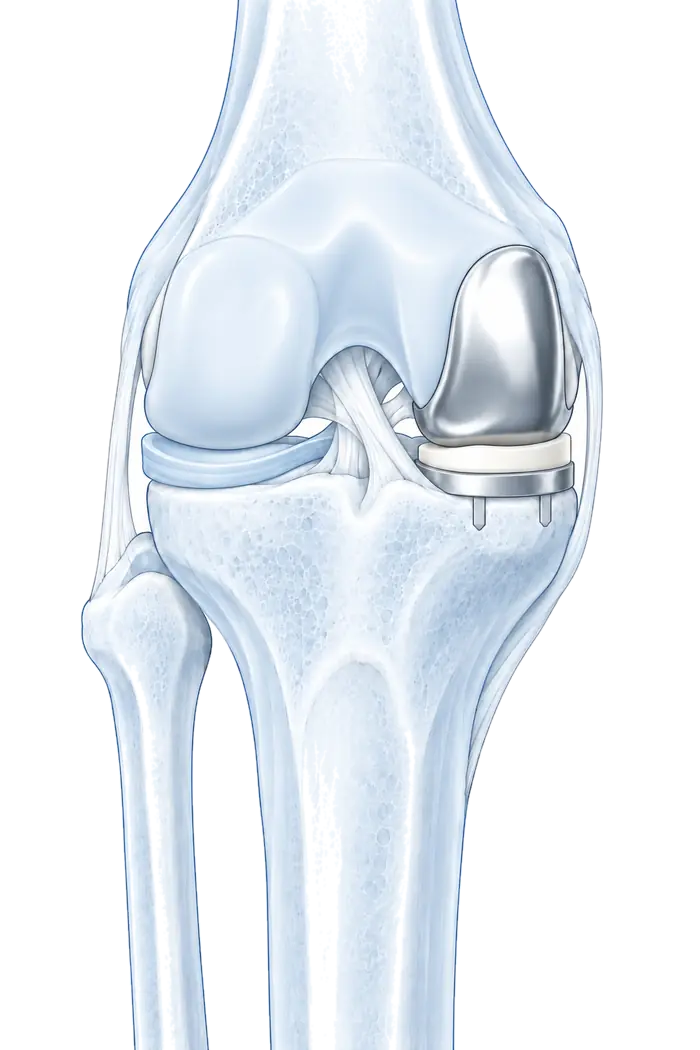
A knee replacement resurfaces worn joint surfaces with implants. A partial knee replacement treats one compartment of the knee and leaves the rest of the knee joint alone.
That means the healthy cartilage stays, and so do both cruciate ligaments (ACL and PCL). For the right patient this is a smaller operation than a total knee replacement. Most patients go home the same day and the early weeks are usually easier.
Partial knee replacement is not the right operation for every patient. That depends on where the arthritis is located. Dr. Harris, a joint replacement surgeon in Chicago, works through that with each patient before recommending one or the other.
A knee replacement is rarely something a patient strictly "needs". It is an elective operation, and there is no point at which surgery becomes mandatory. The right time is when the joint limits the patient’s life, non-surgical care is no longer enough, and the patient decides they are ready.
Osteoarthritis is the most common reason patients have a partial knee replacement, but not the only one. Osteonecrosis, where a portion of bone loses its blood supply, often affects one part of the knee and can be a good fit for a partial knee replacement. So can arthritis that has developed years after an injury or fracture, when the damage stayed in one compartment.
Inflammatory arthritis is the exception. Rheumatoid and psoriatic disease affect the whole joint lining rather than one surface, so a partial knee replacement is generally not the right operation and a total knee replacement is often recommended instead.
Before an operation is being considered, the non-surgical options are worth working through properly.
X-rays and the examination answer some of these questions, although the final decision is sometimes made during the operation once the other compartments can be seen directly. A patient who turns out not to be a candidate has a total knee replacement instead, which is discussed and consented for beforehand.
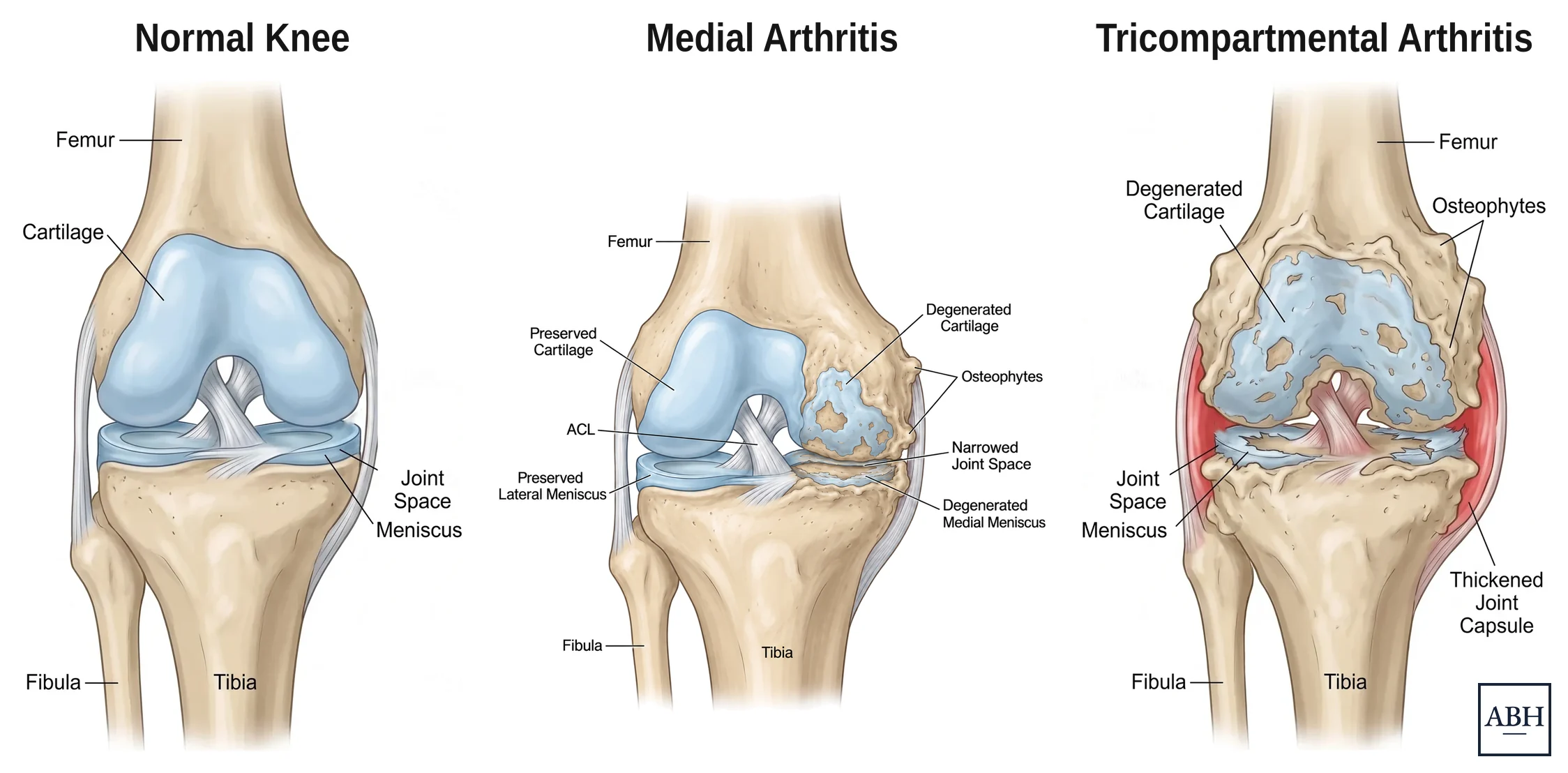
A knee in three states. A partial knee replacement is an option in the middle picture, where one compartment is worn and the rest of the joint is still in good condition.
Because the healthy cartilage and both cruciate ligaments are left in place, the knee often feels more like the patient’s own, and recovery is generally quicker in the early weeks.
The tradeoff is that a partial knee replacement is generally more likely than a total knee replacement to need further surgery later. Pooled across national registries, revision after a partial knee replacement is consistently higher than after a total knee replacement.2 In the Norwegian registry, 84 percent of partial knee replacements were still in place at ten years, against 94 percent of total knee replacements.3 When further surgery is needed, the usual step is converting it to a total knee replacement.
A randomized trial that followed patients for ten years after either operation found function, quality of life and revision rates close to the same in both groups.1 Registries pool every surgeon and every implant together, and surgeon volume matters. Surgeons who perform fewer than 25 partial knee replacements a year have a higher rate of revision for loosening.4 Case selection and surgeon experience probably explain much of the gap between the two sets of numbers.
Arthritis can also appear later in a compartment that was healthy at the time of the partial knee replacement, which would also be treated with another surgery to convert to a total knee replacement.
The inner side of the knee carries more load than the outer side, so it wears out first in most patients. A medial partial knee replacement resurfaces the end of the femur and the top of the tibia on that side, with a bearing between them. It is by far the most common of the three.
Wear confined to the outer side is less common. The operation resurfaces the same two bones on the lateral side. The mechanics on that side are not the same, so implant position and ligament balance are handled differently. Fewer of these operations are done.
Arthritis behind the kneecap on its own is uncommon, and it is treated with a patellofemoral joint replacement, which resurfaces the groove at the front of the femur and the back of the kneecap. That page covers it in more detail.
Robotic assistance is used routinely for partial knee replacement. There is little margin in implant position, since the new surfaces have to work alongside the patient’s own cartilage and ligaments. The robotic-assisted knee replacement page covers how that works and what the evidence does and does not show.
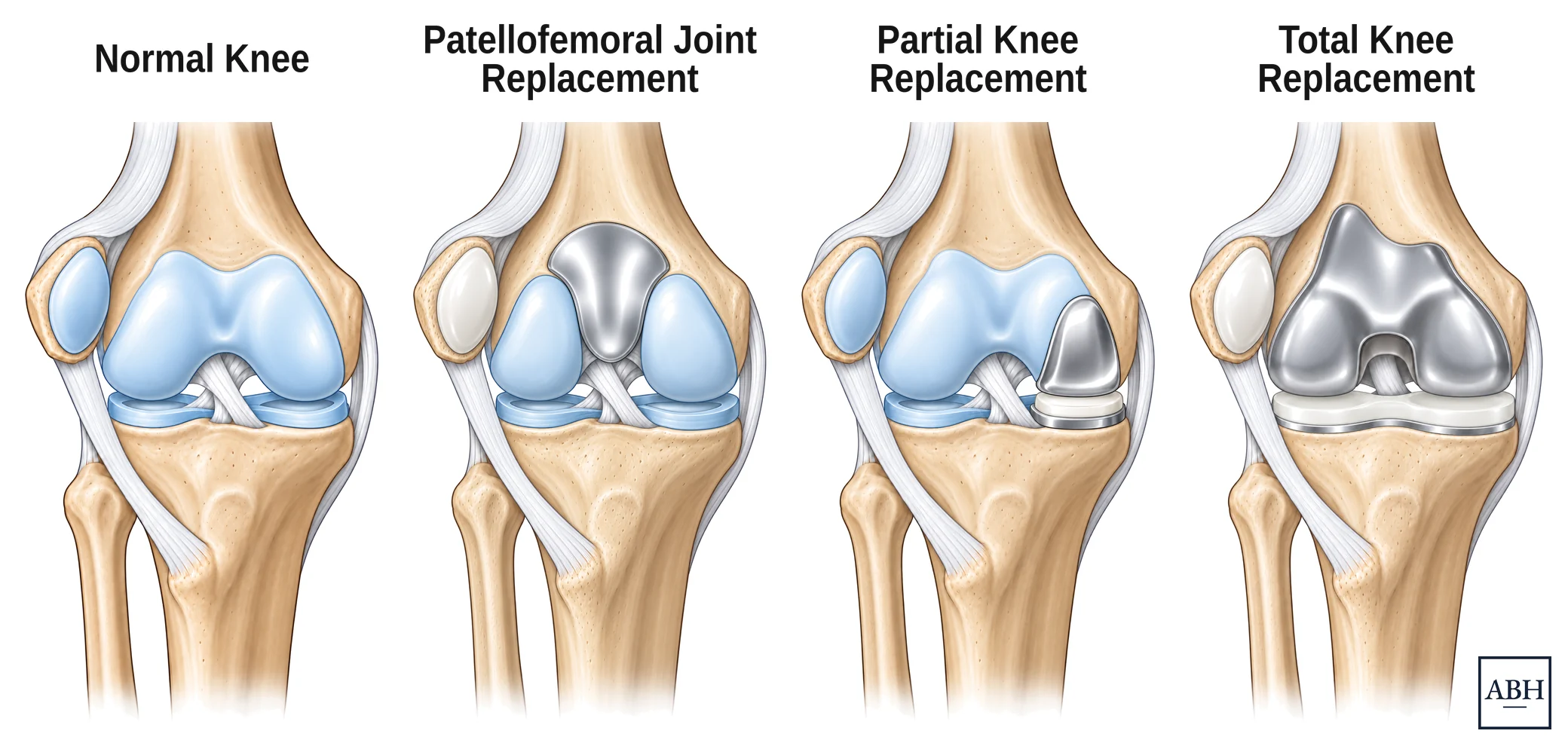
One knee, then the three operations. How much of the joint is resurfaced follows how much of it is worn.
Most patients having a partial knee replacement go home the same day. Pooling studies of nearly 10,000 patients, about 88 percent are discharged the same day, with readmission and complication rates in line with staying overnight.5 Whether it works for a given patient depends on general health, how the anesthetic is tolerated and what support there is at home, so the plan is settled well before the day of surgery.
Patients are up and walking the day of surgery, usually with a walker or crutches for the first several days. Most are off them sooner than after a total knee replacement. Physical therapy starts straight away and focuses on getting the knee straight, bending it, and building the quadriceps back up.
The first few weeks are generally easier than after a total knee replacement. By a few months the difference narrows considerably, and by a year it is generally not noticeable. Knee replacement recovery covers the timeline in more detail.
The risks are broadly those of any knee replacement: infection, blood clots, stiffness, and the chance of further surgery later. The risk specific to a partial knee replacement is that the rest of the knee keeps wearing, which is covered above. Individual risk depends on the patient, and Dr. Harris goes through it case by case.
The knee has three compartments. A partial knee replacement resurfaces only the one that is worn and leaves the rest of the joint alone, including the healthy cartilage and both cruciate ligaments. A total knee replacement resurfaces all three.
It depends on where the arthritis is and what the rest of the knee looks like. Arthritis limited to one compartment, intact ligaments, a deformity that corrects, and reasonable range of motion all point toward it. X-rays and examination answer some of this, and the final decision is sometimes made during the operation once the other compartments can be seen directly. Whether it applies to your knee is a question for an orthopaedic surgeon who has reviewed your imaging.
Pooled registry data shows partial knee replacements are revised more often than total knee replacements. In the Norwegian registry, 84 percent were still in place at ten years against 94 percent of total knee replacements. A randomized trial that followed both groups for ten years found revision rates close to the same, which suggests case selection and surgeon experience explain much of the difference. When a partial knee replacement does need further surgery, the usual step is converting it to a total knee replacement. What this means for a specific patient is worth going through with an orthopaedic surgeon.
Most patients having a partial knee replacement go home the same day. Across pooled studies about 88 percent are, with no rise in readmissions or complications. It still depends on general health, how the anesthetic is tolerated, and what support there is at home, so the plan is settled well before the day of surgery.
Usually in the first few weeks, since less of the knee has been operated on. By a few months out the difference between the two narrows considerably. Individual recovery varies enough that an orthopaedic surgeon should give you the expectation for your own operation.
Many patients say it does. Leaving the healthy cartilage and both cruciate ligaments in place preserves more of how the knee normally senses and controls position. It is a common report and not a guarantee, and it is not the only thing to consider when choosing between the two operations.
Yes. A compartment that was healthy at the time of surgery can wear out later, and that is one of the more common reasons a partial knee replacement is eventually converted to a total knee replacement. This is progression of the arthritis itself.
Routinely. A partial knee replacement leaves less margin for error in implant position, since the new surfaces have to work with the patient's own cartilage and ligaments. Whether it changes the outcome for an individual patient is a separate question and one to raise with an orthopaedic surgeon.
It is usually converted to a total knee replacement. That operation is more involved than a first-time total knee replacement, though generally less demanding than revising one. What is done depends on why it failed, so it should be worked out with an orthopaedic surgeon before anything is planned.
General information for patients and clinicians, not a substitute for advice from your own surgeon.
It comes down to where the arthritis actually is and what the rest of the joint looks like. Dr. Harris reviews the imaging and the examination and explains which operation he would recommend and why. Send a message.