
Patient Guide
Hip Arthritis: Symptoms, Causes and Treatment
What hip arthritis is, how it is diagnosed, how it is treated, and when to consider a hip replacement.
Andrew B. Harris, MD · Last reviewed October 2026
What hip arthritis is, how it is diagnosed, how it is treated, and when to consider a hip replacement.
Andrew B. Harris, MD · Last reviewed October 2026
Hip arthritis is the loss of the smooth cartilage that covers the ball and socket of the hip. As the cartilage thins, the joint surfaces roughen, extra bone forms around the rim, and the joint stiffens and hurts. It generally comes on slowly, over years, and it is one of the most common reasons an adult sees an orthopaedic surgeon.6
Osteoarthritis is the most common kind of hip arthritis, but not the only one.
The signs you may need a hip replacement guide covers the symptoms in more detail, including how to tell hip pain from back pain.
Osteoarthritis is wear of the cartilage over time. Age, genetics and body weight all play a part, and many patients have no single cause they can point to.6
In younger patients, the shape of the hip is often the reason. In hip dysplasia the socket is shallow, so the ball is not fully covered and the cartilage at the edge of the socket carries more load than it was built for.5 In femoroacetabular impingement, usually shortened to FAI, extra bone on the ball or on the rim of the socket pinches the labrum and cartilage with each deep bend of the hip, and over years that can wear the joint.4
Other kinds of arthritis reach the hip by different routes. Avascular necrosis is loss of blood supply to the ball of the hip, which can cause the bone under the cartilage to collapse. Long courses of steroid medication and heavy alcohol use are two of the known causes, and in many patients no cause is found. Inflammatory arthritis, such as rheumatoid or psoriatic arthritis, damages the joint through inflammation of its lining. A fracture or a serious injury to the hip can lead to arthritis years later.6
Hip arthritis is generally diagnosed from the history, the examination and a standing X-ray of the pelvis and hip. Standing films show the joint under load, which is when the space between the ball and socket narrows. MRI is usually not needed, although it has a role when avascular necrosis is suspected, when a fracture is not visible on X-ray, or when the diagnosis is unclear.
Hip pain and back pain often overlap, so both should be examined.
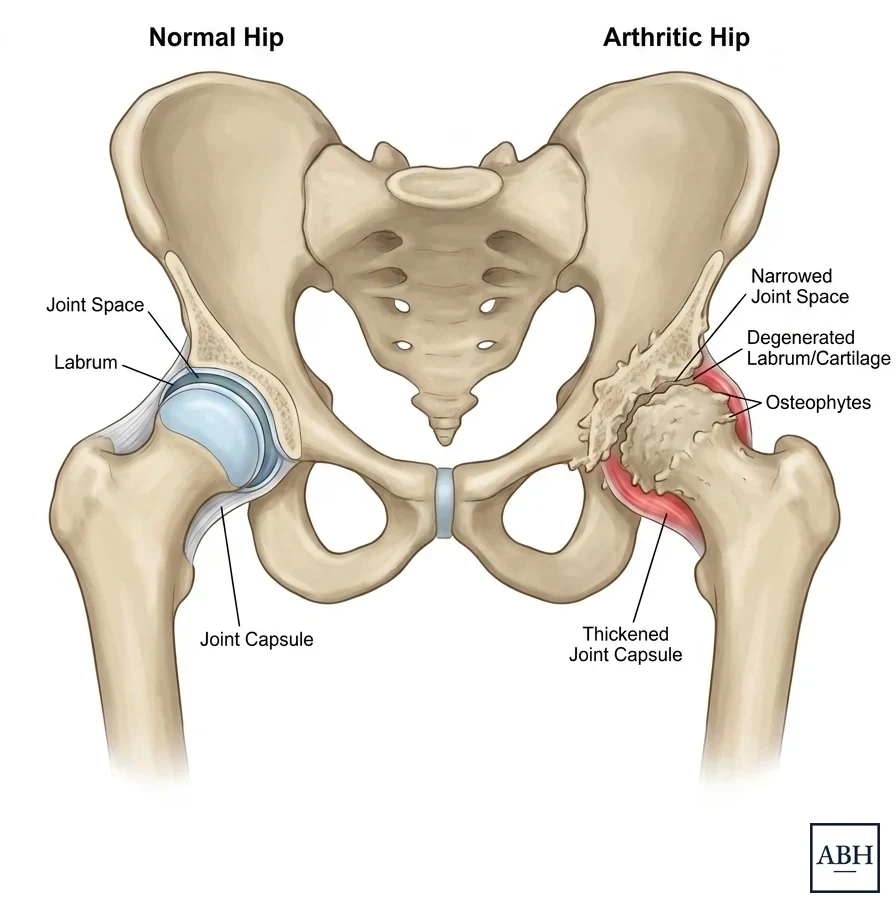
A normal hip on the left and an arthritic hip on the right. The joint space narrows as the cartilage wears, bone spurs form around the rim, and the capsule thickens.
Hip arthritis generally progresses, but the pace varies a great deal. Some hips change little over many years, and others go from mild to severe within a few. There is no reliable way to predict which course an individual hip will take.
X-rays also do not predict how much a hip hurts. In a large study of adults with hip pain, many hips that showed arthritis on the X-ray were not painful, and many painful hips did not show arthritis on the X-ray.3 Treatment is based on the symptoms and how much the hip limits what you do. The X-ray is only one part of that picture.
Most hip arthritis is treated without surgery, often for years. The options below are the ones with the best evidence behind them. They are generally combined, and there is no fixed order that everyone has to work through.
Regular exercise is the first thing the AAOS and American College of Rheumatology guidelines recommend for hip arthritis.1,2 It does not regrow cartilage. It strengthens the muscles around the hip, keeps the joint moving, and in many patients reduces pain. A physical therapist can set up a program and progress it. Walking, cycling and pool exercise are generally well tolerated.
A cane held in the hand opposite the painful hip takes load off the joint with every step, and it is one of the few simple measures that helps right away. Many patients resist it. The American College of Rheumatology guideline recommends one for anyone whose hip pain is affecting how they walk.2
The hip carries several times body weight with each step, so losing weight reduces pain in many patients who are carrying extra, and it lowers the risk of complications if surgery happens later.2
Anti-inflammatory medication (NSAIDs) is the medication both guidelines recommend first.1,2 It reduces pain and helps you stay active. Taken daily for a long time it can affect the stomach, the kidneys and the heart, so it is generally used at the lowest dose that works, and certain medical conditions can make it unsuitable, so check with your physician first. Acetaminophen is a safer option for some patients, although it is generally less effective for arthritis pain. Opioids are not recommended for arthritis pain.2
Injections in the hip are done with image guidance, since the joint is deep, and guidelines recommend them less often than in the knee. A steroid injection can give short-term relief and is sometimes appropriate for a patient with severe arthritis who is not ready for surgery.1 An injection is generally followed by a wait of about three months before a hip replacement, to lower the risk of infection. A numbing (lidocaine) injection is sometimes used as a diagnostic test. If it relieves the pain, even briefly, the hip joint is the likely source.
Gel injections (hyaluronic acid) have not been shown to work better than a placebo injection in the hip, and both the AAOS and the American College of Rheumatology guidelines recommend against them.1,2
Glucosamine, chondroitin and similar supplements are not proven to help in current research and guidelines, though some patients do find individual benefit and the risk is low.1,2
The alternatives to hip and knee replacement guide covers each of these in more detail, with the evidence behind each one.
A hip replacement is rarely something a patient strictly “needs”. It is an elective operation, and there is no point at which it becomes mandatory. The right time is when the hip limits your life, non-surgical treatment is no longer enough, and you decide you are ready. How long you wait is largely up to you.
Some problems are treated sooner: certain fractures, collapse of the bone in avascular necrosis, or infection. Your surgeon will tell you if one applies.
The signs you may need a hip replacement guide covers the decision in more detail, including when it is too early and whether it is possible to wait too long. The hip replacement page covers the operation itself.
No. Cartilage that has worn away does not grow back, and no medication or injection restores it. Treatment aims at pain and function. Most patients manage well for years with exercise, weight control, medication and sometimes an injection, and a hip replacement is the option when those are no longer enough. What is right for you depends on your hip and your goals, so discuss it with an orthopaedic surgeon.
Generally no. Staying active is one of the main treatments, and walking does not wear the joint out faster in most patients. Pain after a long walk is common and usually settles. If it does not, or if a particular distance reliably sets it off, tell your surgeon. A cane, a softer surface or different footwear often helps.
Partly. Osteoarthritis runs in families, and so do hip dysplasia and the hip shape behind femoroacetabular impingement. Having a parent with hip arthritis raises the odds of developing it, although it does not mean the same course, and most of what you can do about it is the same whatever the cause.
Most patients are most comfortable on the side that does not hurt, with a pillow between the knees to keep the top hip level. Sleeping on the painful side is fine if it does not hurt. Pain at night that no position helps is one of the symptoms that tends to push patients toward surgery, and it is a reasonable thing to raise with an orthopaedic surgeon.
Yes. The hip and the knee share some of the same nerves, so hip arthritis is often felt in the front of the thigh and sometimes at the knee itself. Some patients are evaluated for a knee problem before the hip turns out to be the cause. If your knee X-rays look normal and the knee pain has no clear explanation, ask your surgeon to examine the hip.
No. Many patients with hip arthritis never have surgery. A hip replacement is considered when the hip limits your life, non-surgical treatment is no longer enough, and you are ready. Whether and when that happens is largely your decision, made with a surgeon who has examined the hip.
Yes, although it is less common. Hip arthritis at a younger age usually has a reason behind it, most often hip dysplasia, femoroacetabular impingement, avascular necrosis or an earlier injury. Finding the reason helps guide treatment, so a hip that hurts at that age should be evaluated by an orthopaedic surgeon.
General information for patients and clinicians, not a substitute for advice from your own surgeon.
The signs you may need a hip replacement guide covers the decision, and the alternatives guide covers treatment without surgery in depth.