
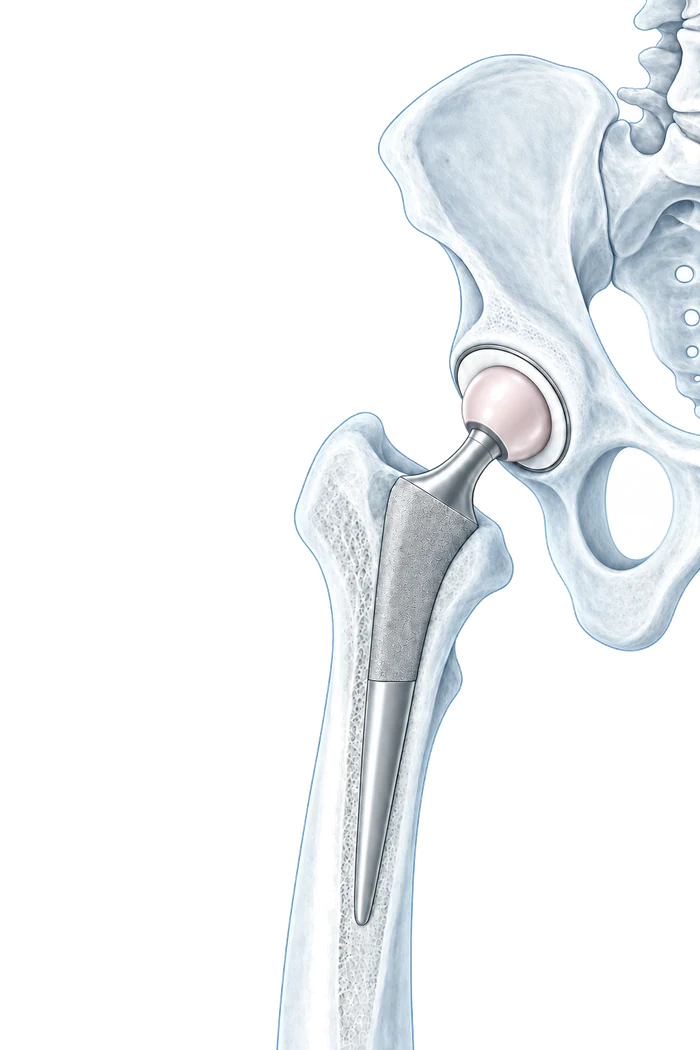
Patient Guide
Outpatient Hip and Knee Replacement
Andrew B. Harris, MD · Last reviewed October 2026
Andrew B. Harris, MD · Last reviewed October 2026
"outpatient" joint replacement is having a hip or knee replacement where you go home on the day of surgery instead of staying overnight. The operation is the same. The anesthesia, the pain control and the preparation at home are set up so that going home the same day is safe.1
Hospital stays after hip and knee replacement have gotten shorter as anesthesia and pain control have improved. Same-day discharge is now common for suitable patients.3,4
Dr. Harris offers same-day discharge to selected patients having a total hip replacement, a total knee replacement or a partial knee replacement. This would be planned before surgery.
Whether same-day discharge is appropriate depends on the patient. Four things are generally considered, and your surgeon and anesthesiologist will go through them with you before surgery.1
Same-day discharge suits patients who are generally healthy and whose medical conditions, such as blood pressure or diabetes, are well controlled. Patients with a medical condition that needs closer monitoring after surgery generally stay at least one night. Age alone is not the deciding factor. Overall health and the situation at home are considered as well.1,2
An adult needs to be at home for the first night or two to help with meals, medication and getting up. No medical training is needed. Nausea, dizziness and pain are most common in the first 24 hours, so you should not be alone.3
Before you leave, a physical therapist will have you walk with a walker and practice stairs if you have them at home. If this does not go well, you stay the night and try again the next morning.
Same-day discharge is for patients who have gone through the preparation, understand the plan for the first few days, and want to go home. Patients who would feel safer staying in the hospital the first night should say so.
Most same-day joint replacements are done under spinal anesthesia with sedation. You are asleep for the operation and the spinal wears off within a few hours. Your anesthesiologist will discuss which type of anesthesia is appropriate for you.3,4
The operation generally takes one to two hours. Afterward you go to the recovery area, and once the spinal has worn off a physical therapist gets you up and walking. Walking within a few hours of surgery is expected and is the main requirement for going home.
Modern pain control after joint replacement minimizes narcotics such as oxycodone and Percocet, and relies instead on a multimodal regimen, meaning several different medications that work in different ways and are taken together. Dr. Harris uses this approach. Local anesthetic injected around the joint during surgery helps for the first several hours, and oral medication is used after that.1
Most patients leave in the afternoon or early evening, once they have walked, eaten, urinated and have their pain controlled with oral medication. In published studies, roughly 90% of patients on a same-day pathway went home as planned.3,4
Most of the preparation for same-day discharge happens before surgery. Your surgeon’s team will go through a list with you. It generally includes the following.
The hip replacement recovery and knee replacement recovery guides cover the weeks after surgery. The OrthoInfo page under Further reading has a more complete checklist.
Yes, for appropriately selected patients. The American Association of Hip and Knee Surgeons’ position statement says outpatient joint replacement is safe and effective when patients are appropriately selected, the surgical team is experienced and a recovery protocol is in place. It also says the decision should be made together by the surgeon and the patient.1
In a collection of 41 studies comparing same-day discharge with an overnight stay found no significant difference in complications, readmissions or patient-reported outcomes.2 Across published same-day studies, about 2% of patients were readmitted within 90 days.3 Programs that added same-day discharge to an existing next-day pathway did not see an increase in short-term complications.5
Patients in these studies were younger and healthier on average than joint replacement patients overall. Same-day discharge is safe when patients are selected carefully, and it should not be pushed on a patient who is not a good candidate.2,3
About 10% of patients on a same-day pathway end up staying.3,4 The usual reasons are nausea, dizziness, pain that is not yet controlled with oral medication, or low blood pressure after the spinal. None of these change the operation or the result. The next morning you walk with the therapist and go home when it is safe.
Some patients are better off planning to stay one night from the start. This is decided in clinic before surgery is scheduled. The stay is generally one or two nights.
Total hip replacement, total knee replacement and partial knee replacement, including patellofemoral joint replacement, can all be done as outpatient procedures in suitable patients. This includes hip replacement through the anterior approach or the STAR approach, and robotic-assisted knee replacement. The surgical approach and the use of a robotic system do not change the plan for going home. Your health and the situation at home determine that.
Revision joint replacement is generally done as an inpatient, since the operation is longer and the early recovery is less predictable.
No. It is the same hip or knee replacement with the same implants and the same surgical approach. The difference is the planning around it: anesthesia, pain control, early walking, and preparation at home. Whether it is appropriate for you is a decision to make with your surgeon.
Yes, for selected patients having a total hip replacement, a total knee replacement or a partial knee replacement. It is planned in clinic and confirmed on the day of surgery, once the patient has walked with the therapist and feels well. Patients who do not fit the pathway stay the night, and that is planned in advance.
The first few nights after a joint replacement are generally the most uncomfortable, whether you are at home or in the hospital. The local anesthetic from surgery wears off overnight, so the first days are when the medication schedule has to be followed closely. Your surgeon’s team will give you a written plan. Take the medication on schedule, before pain builds, and call with any questions.
Generally no. An adult should be at home for the first night or two. They do not need any medical training. They help with meals, medication and getting to the bathroom. A patient who lives alone can still have same-day surgery if someone comes to stay. Your surgeon’s team can discuss what is needed.
Usually not. A walker, a chair with arms and a bed at normal height are enough for most patients. Some patients find a raised toilet seat or a shower chair helpful for the first few weeks. A hospital bed is rarely needed. Your surgeon’s team will tell you what applies in your case.
Neither is better for every patient. In studies of appropriately selected patients, complications, readmissions and patient-reported outcomes have been similar. Going home the same day is reasonable for patients who are healthy, have help at home and want to be home. Staying overnight is reasonable for patients who need closer monitoring or would feel safer in the hospital. Discuss this with your surgeon, and know that the plan can change on the day of surgery.
Generally a few hours after you are up and walking, which for a morning surgery means the afternoon or early evening. You go home once you have walked safely with the therapist, eaten, urinated and have your pain controlled with oral medication. If this has not happened by the evening, you stay the night. The exact criteria vary between surgeons and hospitals, so ask your own surgeon what applies to you.
Both. Some same-day joint replacements are done in a hospital and some in an ambulatory surgery center. A surgery center does not have an overnight option, so the setting depends on the patient’s health. Your surgeon will discuss which is appropriate.
General information for patients and clinicians, not a substitute for advice from your own surgeon.
The hip replacement recovery and knee replacement recovery guides cover the weeks after surgery, and the procedures page covers each operation.
Dr. Harris sees patients in Skokie, across the North Shore, and in the city of Chicago.